
Searching Yuma County Criminal Dockets
The free Colorado Judicial Docket Search comes first for a scheduled Yuma County criminal hearing. Use it before anything else. Pick the 13th Judicial District, Yuma County, and the right court type. The form needs a date plus one more filter. A full case number works best, though a party or attorney name can narrow things down. District criminal cases usually carry the class 2025CR..., while County Court misdemeanors use 2025M.... Watch the live labels if a class changes.
One calendar row never equals the whole Yuma County criminal register of action. The Judicial Branch points to CoCourts/LexisNexis Colorado Courts Record Search for the chronological case history. That service charges for real-time state data. It shows no filed document images, and it is not the official record. Search in that order and you stay tied to the correct court and case.
- Identify District Court, County Court, or the municipal court named on the citation or notice.
- Enter Yuma County, the date, and a case, party, or attorney filter in Docket Search.
- Match the year, case class, sequence, court, and division before reading an event.
- Use CoCourts when the dated Register of Action is needed rather than just the next setting.
- Request the charging paper, order, disposition, sentence, or certified copy from the filing court.
Yuma Criminal Courts Split Cases
One felony in Yuma County can leave a trail across two criminal dockets. It often starts in County Court. A preliminary hearing or early setting shows up there first. Once the prosecution files the felony formally, the case shifts to District Court. The new file may carry a different case number or even a different charge class. So a one-court docket search can mislead you. It might pull up an old hearing date. The live Yuma County case sits in the other building's records.
| Court | Criminal work | Custodian |
|---|---|---|
| Yuma County District Court | Felony cases and later District Court proceedings | Yuma Combined Court clerk |
| Yuma County Court | Misdemeanors, traffic cases, and preliminary felony complaints | Yuma Combined Court clerk |
| Yuma or Wray Municipal Court | Violations charged under the city's charter or ordinances | The named municipal court |
Clerk work in Yuma runs through one office. The Yuma Combined Court is that clerk. It keeps criminal court records for both state District Court and County Court. Don't confuse that clerk with the elected County Clerk and Recorder. City ordinance cases stay with the municipal court that opened the file.
Inside a Yuma County Criminal Docket
Start with the label block, not the charges. Check the court, case number, class, filing date, division, and status before anything else. Then work through the docket events in order, oldest to newest. Charges can shift. An amended charging document may change the opening allegation, so the first entry is not always what the case ends up saying. A bond entry tells you about pretrial release only. It says nothing about guilt.
| Case identity | Year, CR or M class, sequence, filing court, division, status, and filing date. |
|---|---|
| Charge events | Complaint or information, available offense description, class, and statute reference. |
| Appearances | Counsel entries, advisement, arraignment, pretrial conference, motions, plea, and trial settings. |
| Rulings | Minute-order labels and docketed orders, which may require a separate document request. |
| Outcome | Plea or verdict, dismissal or conviction, sentence, review, and appeal events. |
| Financial entries | Public costs, fines, restitution, payments, or balance references, subject to clerk confirmation. |
Commercial register-of-action vendors list entries, not the filed papers behind them. If a line reads "minute order," ask the clerk for that order itself. The Colorado record and document request form lets you pick the paper you want, from a Complaint or Information to a Disposition and Sentence Order, a Protection Order, a Ticket, or a full Register of Action.
Read Yuma Criminal Docket Events
A Yuma County criminal docket lists events one at a time. Each entry stands for a separate step. Read them that way. A plea, for example, is not the sentence, and a disposition can close one charge while probation or a post-sentence review keeps later events on the court calendar. The word “Pending” tells you only that no final disposition has posted in the record you are viewing.
- Advisement
- An early hearing about allegations, rights, release, and the next procedural step.
- Bond
- Conditions or financial assurance tied to release before disposition, not a finding of guilt.
- Disposition
- The procedural result, such as dismissal, acquittal, guilty plea, conviction, or closure.
- Sentence
- The penalties or conditions ordered after a qualifying plea or finding.
- Vacated setting
- A hearing removed from the calendar; it does not by itself dismiss the case.
Labels like “deferred disposition” or “deferred judgment” carry real weight, so get the actual order. Pull the signed Yuma County criminal order and the governing route behind it. Do not read the label as an automatic conviction or dismissal, because the signed order controls over a short portal tag.
How a Criminal Case Moves
Most state criminal cases follow a familiar arc: charge filed, advisement, counsel appearance, bond decision, arraignment and plea, pretrial settings and motions, then plea or trial, disposition, sentence, and review or appeal. Not every Yuma County criminal case hits every stage. Some end early. A transferred felony complaint can even open a second file at the District Court level, so one case may leave two docket trails.
Docket flow: Filing › Arraignment › Pretrial › Plea or Trial › Disposition › Sentencing
Compare every setting before you assume anything. Older events are useful history. But they may not be the next court date anymore. The best guide is the newest non-vacated entry, paired with the newest case-specific notice. The local court states that appearances happen in person unless a court order says otherwise.
Missing Yuma Criminal Search Results
A blank results screen does not mean the Yuma County criminal docket holds nothing on that person. The miss usually has a plain cause. A misspelled name, the wrong case class, or searching the wrong court level will hide a file, and so will a sealed case or a limit on remote access to court records. A felony complaint can shift levels. If so, run the docket search at the other state court. For a city charge, skip the state system. Call the municipal court printed on the citation instead.
Best fallback: Call the Yuma Combined Court at 970-592-6120, email yumacountycourts@judicial.state.co.us, visit 310 Ash Street, Suite L in Wray, or use the online record request.
Prefer paper? The state request form can be downloaded, filled out, and mailed. Before you drive over, ask the clerk whether a courthouse workstation is open to the public. The local page makes no promise about one. Older files sometimes sit off-site, and retrieval may add a real cost. When you want an official disposition from the court docket, name the case. Pick the Disposition/Sentence Order itself, not just a search result.
Courts That Hold Criminal Dockets
Criminal dockets in Yuma County live in a few different hands. Yuma County District Court and Yuma County Court share the Combined Court clerk. That clerk sits at the Yuma County Courthouse. The District Court docket carries felony prosecutions. County Court handles misdemeanors and some early felony complaints. The City of Yuma Municipal Court and Wray Municipal Court keep their own ordinance cases separately.
Where a charge was filed matters more than where an arrest happened. Check the summons, the docket row, the case number, or the order for the filing court's name. A city police case might land in municipal court as an ordinance violation. Or it might be filed in County Court under state law. If the court name leaves you guessing, call the Combined Court or the city court. Either office can tell you whether it holds the file.
Yuma Criminal Sealing Search Limits
Colorado's Sealed Case Search does one narrow job. Only the defendant can use it. It works one case at a time, and verifies just the automatic sealing covered by C.R.S. §13-3-117. Petition-based sealing and other nonconviction routes fall outside its reach. For those, the Judicial Branch's record-sealing help lays out the forms and procedures. That official page shows why these checks answer different questions. A defendant-only sealing check and a broad public Yuma County criminal docket search are not the same thing.
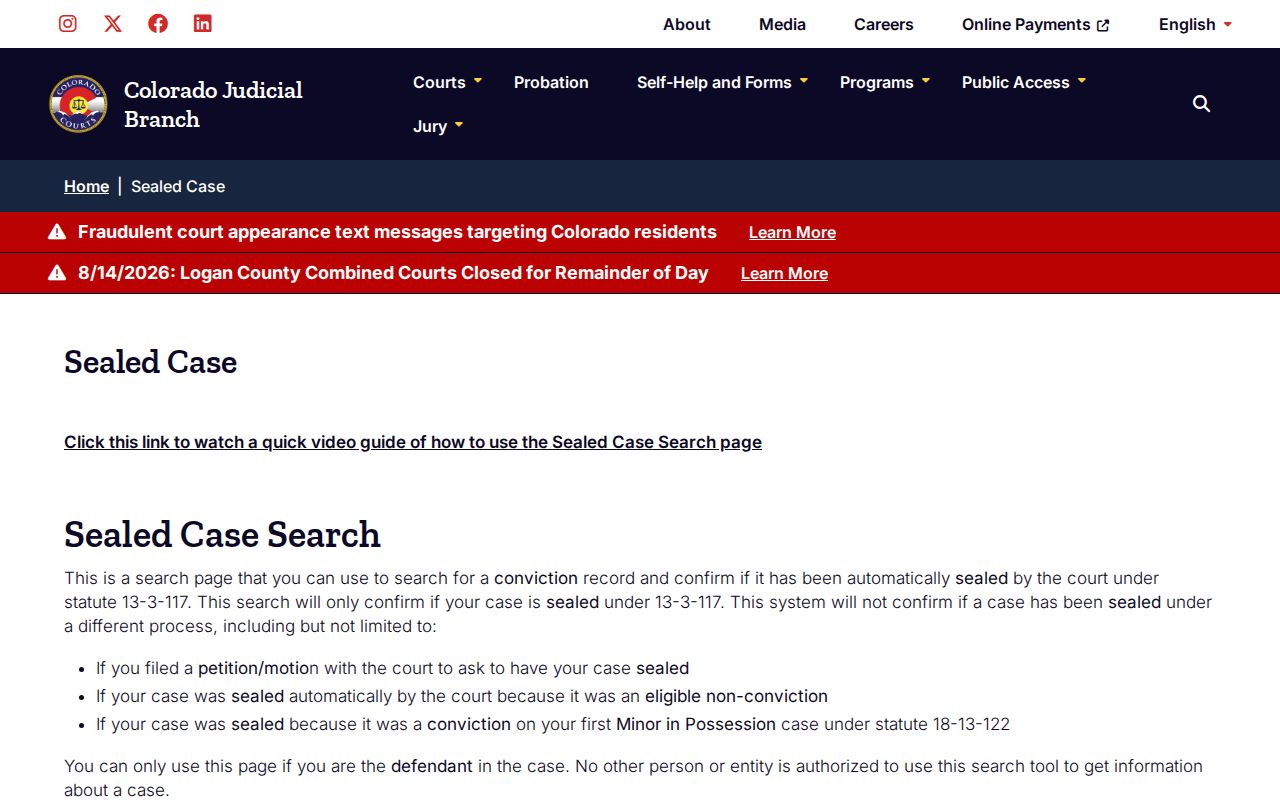
Sealed material stays sealed. The search route above only confirms eligibility to a single defendant. Everything else belongs with the court holding the case and the Judicial Branch's sealing forms.
Sealed Dockets and Public Access
Colorado treats criminal court records as open by default, but the default has firm edges. Remote access can be narrower than what you get inside a court facility. Sealed or expunged cases, individually sealed documents, presentence reports, criminal-history reports, treatment information, confidential victim data, and protected identifiers stay out of a Yuma County criminal docket search.
Colorado access rules:
Chief Justice Directive 05-01 sets the statewide public-access framework for court records and distinguishes remote from facility access.
Colorado Rule of Criminal Procedure 55.1 presumes criminal court records open unless law or a valid order restricts access.
Colorado Criminal Justice Records Act provisions authorize custodian rules and lawful limits on disclosure.
A public result may show only a caption or a single event. It may show nothing at all. That empty screen is not proof. The file may exist even so. Ask the clerk what can be inspected, what identification is required, and whether a redacted or certified version can be released.
Even an open Yuma County criminal case can hold protected content. Social Security numbers, driver-license numbers, financial-account data, confidential victim identifiers, and medical or treatment material may be stripped from public view. Presentence reports and criminal-history reports sit outside the ordinary public docket entirely. Access at the facility may reach further than remote access. The same legal limits still apply. The Yuma Combined Court makes each access call. It applies the current directive, the statutes, the rules, and any case-specific order.
Order Yuma Criminal Case Proof
When you need proof, not just a docket search, go through the Yuma Combined Court. The online request usually draws a response within three business days. The downloadable form quotes three to five business days. Treat those as response targets, not delivery guarantees. The clerk may quote fees or ask for more detail first.
The fee schedule is specific. A nonparty name search with a Register of Action runs $5. Electronic or coin copies cost $0.25 per page. The downloadable fee grid lists court-produced paper at $0.75 per page. Certification or exemplification adds $20 per document plus copy charges. Research or redaction runs $30 per hour after the first hour, billed in 15-minute increments.
Be precise with your request. Give the court level and the full case number. Add the party name, filing year, and the exact item you need. A Disposition/Sentence Order shows the signed result. An ROA gives the concise event history. They are not interchangeable. The certified clerk copy is the official Yuma County criminal record.
A transferred felony needs both known numbers. Add a short note on how the County Court and District Court files connect. That helps the Yuma County criminal clerk find the early complaint and the later felony file. A city ordinance charge goes to the municipal court instead. The filing court is the only office that can certify its own record.